
Here's a quick assignment. I’m going to have you look at a quilt, and notice what first catches your attention. Then, read the next paragraph. OK...now look at Cosmo Boogie.
Whatever you noticed first is the
focal point of the quilt. It is determined by the area with
the highest contrast. The very strongest type of contrast is
variation in value, that is, light and dark. So, most readers
will be attracted to the white flower in the top right quadrant,
because of the strong value contrast it has with the black
background. Other types of contrast are color and brightness,
and one of these may have gotten your attention.
Focal point matters for a couple of reasons. First, since the viewer's eye will go there first, you'd probably like to make it something important. In the case of this quilt, that's a flower, rather than a piece of foliage. If you're doing a portrait of your grandchild, you'd probably like the face or eyes to be the focal point, rather than the flower the child is holding. Knowing that contrast will attract the viewer's eye, you will have the opportunity to manipulate this to your advantage.
The location of the focal point also contributes to the feel of the quilt. A centralized focal point is very stable. This would be appropriate for a portrait, but it could be a little boring in some other instances.
Every quilt has four spots that are considered highly desirable for the focal point. These are sometimes called sweet spots. If you mentally divide your quilt into thirds, both top to bottom and left to right, the intersections of those lines form the four sweet spots.
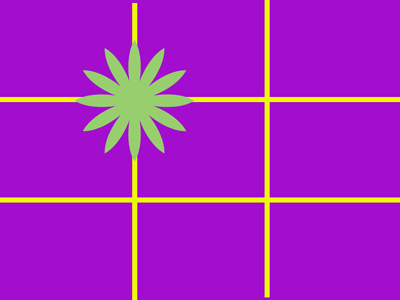
In the quilt you looked at, the focal point is located at the top right sweet spot. (Note that the sweet spots are not always the best locations for focal points. Always consider what's most appropriate for each individual quilt.)
Finally, examine the quilts on this page, and determine the focal point locations for a few. Don’t try to logically analyze this. Instead, let your EYES decide! For instance, look at Gold Pear. The pear is in the exact center, but is the focal point?
©2007-2012 Ellen
Lindner
|